The simple answer is that they probably didn’t. There were two groups of people. The Matthew account of the Triumphal Entry clearly delineates between the two.
It was a pilgrimage to Jerusalem.
Jesus began telling the disciples that He was going to Jerusalem to die months before this trip. The book of Matthew records three separate instances where Jesus told his closest followers of his plan to go to Jerusalem where He would be tried and crucified. The first was when they were in the far north near Caesarea Philippi (Matthew 16:21-23), the second was just after the transfiguration (Matthew 17:22-23), and the third was on the road as they traveled toward Jericho on their way to Jerusalem (Matthew 20:17-19).
The timing of this journey was significant. Jesus was going to Jerusalem for the Passover. Jews from all over the world were making this same trip at the same time. Jesus chose this timing on purpose. Any Jew listening to Matthew being read for the first time would recognize the significance of the timing and would be able to picture in their own minds the events as they unfolded.
Estimates vary widely regarding the year-round population of Jerusalem during the time of Christ. Cousland[i] estimates the population at around 100,000, yet during the Passover Pilgrimage the population could swell to as many as 2-3 million. There was no place in Jerusalem itself to house all the pilgrims. They camped on the hillsides surrounding the city and tens of thousands of campfires covered the hills as people and animals anticipated the Passover observance.
All the main roads to Jerusalem would be packed with hundreds of thousands of people in the week before the Passover. Jesus and the disciples were traveling in this crowd.
The spectacle of the blind men at Jericho.
The last encampment before the final trek to Jerusalem was at Jericho. People would rest, sometimes for a day or two, before they made the final push. The final leg to Jerusalem was an 18 mile hike, with a 3400 foot rise in elevation. It would be like hiking with a full pack with your full family out of the Grand Canyon. The Jericho to Jerusalem hike is 7 miles longer, and two thirds of the elevation rise.
As they camped at Jericho, people recognized Jesus and crowded around Him. They would go in and out of the Jericho to get supplies. It was there that two blind men called out to Jesus to heal them—and He did (Matthew 20:29-33). This would have ignited the crowd. They knew that Jesus was going to Jerusalem, and they hoped that He was the Messiah and something remarkable would happen.
The Jericho Road.
As Jesus and the disciples climbed from Jericho to Jerusalem, there must have been a crowd that surrounded them. The pilgrims traveled in caravans for safety and company. They would sing the Psalms of Ascent to pass the time, build the excitement, and stay encouraged on the grueling final hike.
As they crested the Mount of Olives, Herod’s Temple would burst into full view. This was a sight that many of these pilgrims had longed to see, and many would be seeing it for the first time. Many had to believe that they were not just going to enter the Jerusalem but were going to do so in the company of the promised Messiah.
Jesus chooses to reveal Himself.
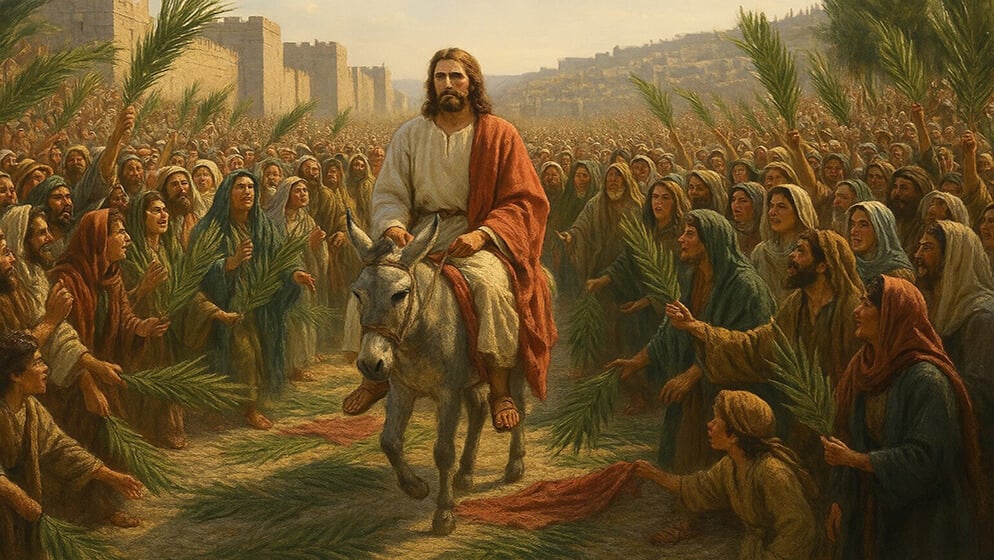
As they came to Bethphage, Jesus commanded the disciples to get a donkey and its colt from a nearby village. The crowd watched. When the disciples returned with the donkey and colt and they placed Jesus on it, the crowd burst into a frenzy. They knew this most significant Messianic prophecy of Zechariah 9:9.
“Rejoice greatly, O daughter of Zion!
Shout, O daughter of Jerusalem!
Behold, your King is coming to you;
He is just and having salvation,
Lowly and riding on a donkey,
A colt, the foal of a donkey.
I will cut off the chariot from Ephraim
And the horse from Jerusalem;
The battle bow shall be cut off.
He shall speak peace to the nations;
His dominion shall be ‘from sea to sea,
And from the River to the ends of the earth.’
The connection not accidental and they knew it. Jesus was PURPOSEFULLY choosing to fulfill this prophecy and claim Himself as the fulfillment as He entered Jerusalem. This was it! “He claiming His throne!” they thought. Jesus was declaring Himself to be the Messiah as He entered the City and the Temple!
The crowds thronged before and behind Jesus. This is not the Sunday School image of a few children happily casting palm branches in front of Jesus. The crowd would have easily numbered in the tens of thousands. It was bustling, pushing, running, casting down branches, shouting, cheering, singing. It would have rivaled the energy of a World Cup Soccer match.
As they accompanied Jesus, they sang the Hillel, the song of praise (Psalm 118). Imagine a crowd of thousands bursting out into a single song. I believe they sang the entire Psalm. It is one of the most clearly Messianic Psalms. The word “Hosanna” which means “save us” comes from the Psalm. The words of verses 25-26 are recorded in the text of Matthew but consider the significance of these words being sung by the crowd as they descended toward Jerusalem.
Open to me the gates of righteousness;
I will go through them,
And I will praise the Lord.
This is the gate of the Lord,
Through which the righteous shall enter.
I will praise You,
For You have answered me,
And have become my salvation.
The stone which the builders rejected
Has become the chief cornerstone.
This was the Lord’s doing;
It is marvelous in our eyes.
This is the day the Lord has made;
We will rejoice and be glad in it.
Save now [Hosanna], I pray, O Lord;
O Lord, I pray, send now prosperity.
Blessed is he who comes in the name of the Lord!
We have blessed you from the house of the Lord.
The second group of people.
The text of Matthew clearly indicates two groups of people. There were the thousands of pilgrims surrounding Jesus, shouting and rejoicing, but observing this unfold were the inhabitants of Jerusalem. Perhaps they watched from the Temple Mount, on the roads surrounding Jerusalem, or atop the walls of the city. These where the religious leaders, priests, and governmental officials. As they looked at this massive crowd descending the Mount of Olives, shouting out Messianic prophecies, and following this unassuming man humbly riding on the colt of a donkey, they reacted in a much different way.
Matthew says they were “shaken” as with fear (Matthew 21:10). They wanted to know who this was that commanded so much attention and was so adored by the crowds. The answer terrified them. The crowd said that He was “the Prophet” from Nazareth. They did not say He was “a prophet.” “The Prophet” was a reference to the Messianic prophecy in Deuteronomy 18:15 in which the New Moses would arise and be heard by the people.
The Jerusalem inhabitants had allied with the Romans. They enjoyed prosperity and a sense of peace. They did not want to be saved. They enjoyed their lives, influence, power, and wealth. They had no confidence in a Galilean prophet to deliver them from the powerful Romans. Even if Jesus was surrounded by tens of thousands of followers, they would be no match against the might of a Roman army. To them, this appearance of Jesus was a threat to their enjoyable status quo.
This is the group of people that conspired to send Jesus to His death in the coming week. This is the group of people who stood before Pilate and shouted, “crucify Him.” This is the group that mocked Him as He hung between heaven and earth as the eternal sacrifice for sin. They preferred their present comfortable lives over the soul-saving work of the Promised One.
Maybe there were a few among the pilgrims that crossed over from shouting “save us” to “crucify Him.” Among the pilgrims, there were no doubt thousands who went home, mystified by the events that had transpired in Jerusalem that week. But the Book of Acts records that many pilgrims remained for a long period of time, and the early Jerusalem Church was populated with Jewish pilgrims from all over the world. They had seen it all—the Triumphal Entry of Jesus into Jerusalem, the preaching of Jesus during the week, the crucifixion of Jesus on the cross, and then the incredible claims that He had risen from the dead. This would have all happened while the pilgrims remained in the vicinity of Jerusalem for the Passover observance. It seems that some either remained or returned to join with the thousands of who heard the preaching of Peter on Pentecost, were converted to Christianity, and stayed to form the first Church in Jerusalem.
Like always—some rejected Him, some wondered about Him, and some eventually believed.
For what profit is it to a man if he gains the whole world, and loses his own soul? Or what will a man give in exchange for his soul? Matthew 16:26
Audio version of this post: Why Did the Triumphal Entry Crowd Turn on Jesus a Week Later?
______________________________
[i] J.R.C. Cousland, The Crowds in the Gospel of Matthew, Brill (2002), p. 60. Other modern scholars estimate between 80,000 and 100,000. The population was significantly higher during the Roman war in 70 AD as people fled to Jerusalem for safety and to fight.
Discover more from Proclaim & Defend
Subscribe to get the latest posts sent to your email.