
Though largely neglected in modern historical accounts, Jonathan Edwards (1703-1758) remains one of the most influential figures in colonial American history. He ranks among the brightest intellectual lights this nation ever produced. A 19th century president of Princeton University, writing of Edwards’s character, said, “He was, in the estimation of the writer, one of the most holy, humble, and heavenly minded men that the world has seen since the apostolic age.”
After graduating from Yale University at age 17, Edwards went on to distinguish himself as a pastor, theologian, philosopher, scientist, author, and educator. In 1758, he died of smallpox shortly after being installed as Princeton University’s first president.
What little place Edwards does hold in modern secular imagination is as a harsh ecclesiastic, spewing unforgiving denunciations from the pulpit on the ignorant and impressionable. This is an unfortunate caricature of his true self.
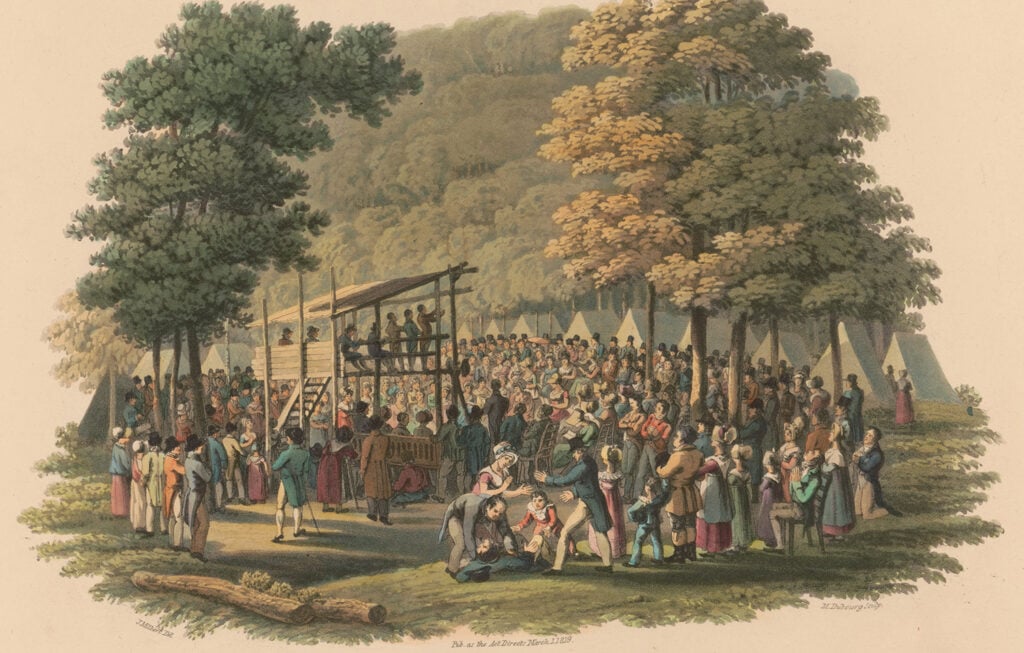
In the decades prior to the American revolution, the British colonies as well as much of Great Britain itself experienced a spiritual revival known as the Great Awakening. Jonathan Edwards was one of the leading voices in this influential religious movement. He preached a notable sermon in Enfield, Connecticut on July 8, 1741, entitled “Sinners in the Hands of an Angry God.” As he preached, many in the congregation responded with weeping, and audible cries for mercy. While unusual, the reaction of the congregation in Enfield was not unique. The powerful revival that swept through the colonies resulted in many thousands converted to Christ under the preaching of Edwards and several others such as George Whitefield and Gilbert Tennant.
While Edwards and his contemporaries preached mercy, love, and grace, they also declared boldly the doctrine of eternal retribution. Edwards explained, “It is very true that ‘preaching hell cannot frighten men into religion;’ but it may frighten them into serious thought, and secure to religious truth that attention, without which it cannot save the soul … It remains an awful truth that men will not give any efficient attention to these things till they have been first brought to see their need of them. Till then, all they hear about the mercy of God only gives them courage to neglect him.” Edwards’s understanding about the essential place of judgment in the gospel message is consistent with Scripture. The apostle Paul began his lengthy treatise on the gospel in his letter to the Romans, not with the subject of mercy, but with the wrath of God. (Rom. 1:17) When he stood before the Roman governor Felix, Paul “reasoned of righteousness, temperance, and judgment to come.” (Acts 24:25) Jesus told His disciples that when the Holy Ghost came, He would convict the world of sin, righteousness and judgment. (Jn. 16:8) It has been pointed out often that in the Bible Jesus spoke more of hell than of heaven. What is perhaps the best-known verse in all the Bible, John 3:16, declares the love of God for the whole world. But it also asserts, in addition to the promise of everlasting life for those who do believe, that those who do not believe in God’s Son will perish.
Nearly two and a half centuries have passed since the Great Awakening. The world Edwards knew is gone. However, truth remains. The Bible still declares that we are sinners in the hands of an angry God.
It is common to believe that the present generation is special and therefore must be reached in a special way and served with a special message. Many insist that the digital and consumer age needs a consumer-friendly message. C.S. Lewis rightly referred to the attitude that the contemporary generation is somehow special compared to previous generations as “chronological snobbery.” Clearly, technology has advanced, and culture has changed. However, the nature of mankind remains the same. We are not so very special. May God give us the humility to see this.
The present generation, like each one prior to it, needs to hear and heed the gospel – the full, unedited, and unaltered message of salvation from sin through repentance and faith in Christ. It may be that this present generation is cursed by hearing only enough to give them, as Edwards said, courage to neglect God.
“He that believeth on the Son hath everlasting life: and he that believeth not the Son shall not see life; but the wrath of God abideth on him.” (Jn. 3:36)
David A. Oliver is the pastor of Ashley Baptist Church in Belding, MI.
Discover more from Proclaim & Defend
Subscribe to get the latest posts sent to your email.