
There is a lot of talk about revival lately.
Even secular media types referred to the events surrounding Charlie Kirk’s memorial service as a “Christian revival.” However, the discussion is not new, it is just amplified in the wake of Kirk’s assassination. Young people are returning to religion in record numbers. Videos of mass baptisms abound. This phenomenon seems to be a reaction to the overbearing nature of woke thinking on people who want to live reasonable lives. Young people have especially been indoctrinated with it.
Charlie Kirk was especially adept at opposing the ravages of woke thinking on our culture, and he was especially good and explaining it on the basis of his Christian world view. People are realizing that a Christian world view is reasonable and provides the only cognitively consistent response to the insanity our country has endured—especially over the last 17 years.
However, a return to religion in a culture is not necessarily revival. It could be just a cultural rebalancing, even if many of those are turning to true faith in Jesus Christ. In the worst case, a “Christian revival” can be an emotional social contagion in the same way that transgenderism has been over the last decade—albeit a good and much less destructive one.
It all depends on how we want to define the word revival.
In his signature work, Knowing God, J. I. Packer explains revival the following helpful way.
Revival means the work of God restoring to a moribund church, in a manner out of the ordinary, those standards of Christian life and experience which the New Testament sets for as being entirely ordinary; and a right-minded concern for revival will express itself not in a hankering after tongues (ultimately it is of no importance whether we speak in tongues or not), but rather in a longing that the Spirit may shed God’s love abroad in our hearts with greater power. For it is with this (to which deep exercise of soul about sin is often preliminary) that personal revival begins, and by this that revival, once begun, is sustained. (p. 119).
Consider the key elements of Packer’s description.
Revival usually occurs in an out of the ordinary manner.
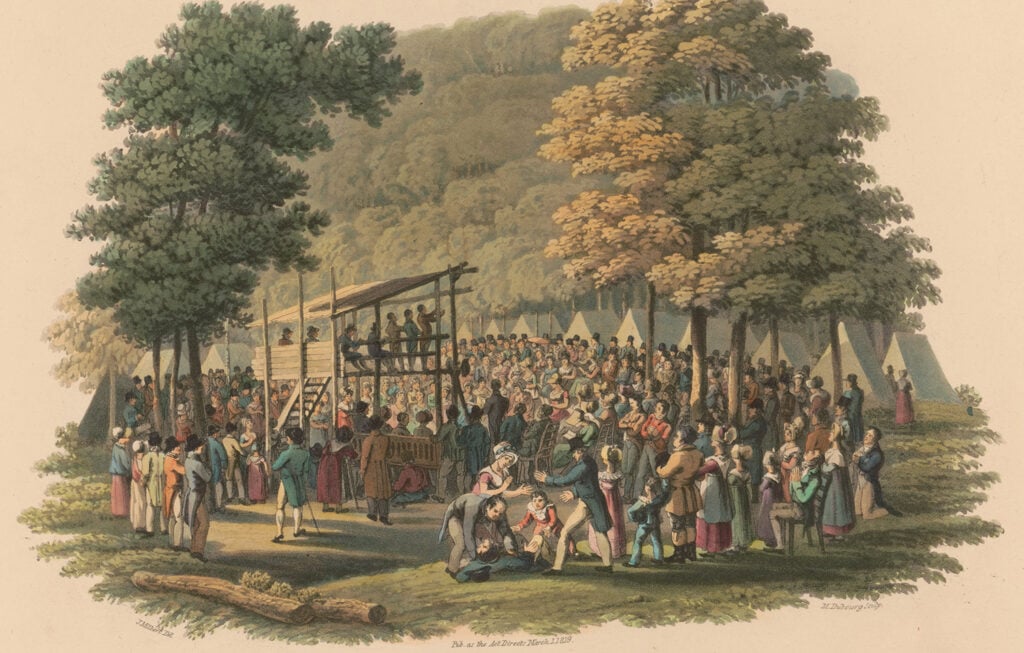
God does sometimes work in extraordinary ways among groups of people. Some would like to explain away all such historical revival events as strange fire. But we have examples of such works of God in scripture—the children of Israel under Haggai, the events surrounding Pentecost and the early church, and the response of the Jerusalem Church to the judgment on Ananias and Sapphira.
It would be unwise to seek to explain away all events associated with the Great Awakenings, the Prayer Revivals of the mid 1800’s, the East Africa Revival, and others as just emotional manipulation.
Revival returns the church to ordinary New Testament Christianity.
By ordinary Christianity, Packer means New Testament normative Christianity—Christianity as the New Testament intends it. We have come to define weak, powerless, self-centered, manufactured, or even dead faith as ordinary Christianity and it is far from it.
True revival results in transformed lives, not just professions of faith, baptisms, or crowded altar calls. True revival is proven over time.
Revival is not focused on spectacle.
Spectacle gets our attention. It did is Jesus’ day as well. The crowds, the healing, demons being cast out, the rebuke of the religious leaders—all these things attracted eyes to the ministry of Jesus. But the true results of Jesus ministry over three years of miraculous ministry were in the transformed lives of 120 people in an upper room praying and waiting for the coming of the Holy Spirit.
Revival seeks the love of God shed upon our hearts by the Spirit of God.
Everyone should read Packer’s classic, Knowing God. But maybe the most remarkable portion of his book is Chapter 12 on the Love of God. We don’t talk about the love of God enough. According to Romans 5, the Holy Spirit spreads His love widely in our hearts. Romans 8, in one of the most poetic passages of the New Testament exalts how inseparable we are from the love of God. 1 Corinthians 13 stands out in the flow of that Corinthian epistle as the pillar upon which all the other principles of the book rest.
All Christians, every day, should marvel, exult in, be humbled by, the constant flood of God’s love poured out on us. It should be our most pervasive thought.
Revival involves repentance from sin because it is sin that hinders our reception of love of God in our hearts.
More conservative Christians love to focus on the repentance aspect of revival, while others prefer to emphasize people coming to salvation. If the love of God is the most pervasive though of the Christian, then repentance from sin is the necessary antecedent to its full experience. We cannot experience the love of God in salvation until we turn from idols, dead works, or unbelief to the grace that is found in Christ alone. For believers, it is only our sin that separates us from the full fellowship and the full daily experience of His love. Repentance is not the substance of revival, it is its antecedent.
Revival is always personal.
While God deals with groups as groups, the New Testament clearly teaches that we each walk with God in a very personal way. If revival is not personal—even if repeated at the same time, thousands of times over in a specific location—it is not true revival. God changes individual people and individual hearts. Therefore, my own personal revival is just as important to me as any widespread revival. The formula for this personal revival is found in James 4:7-10.
Revival is sustained by this same focus.
Social contagions fade over time; a real work of the Spirit is sustained by the Spirit of God spreading the love of God in our hearts continually.
As God has drawn me, convicted me, and wrapped me with His love in the last few months, I am reminded that this is not some extraordinary process that is happening to me. This is what the Christian life is supposed to be. It is the sublimely ordinary life of the true Christian.
O Saviour, as my eyes behold
The wonders of Thy might untold,
The heav’ns in glorious light arrayed,
The vast creation Thou hast made—
And yet to think Thou lovest me—
My heart cries out, “How can it be?”
How can it be? How can it be?
That God should love a soul like me,
O how can it be?
As at the cross I humbly bow
And gaze upon Thy thorn-crowned brow,
And view the precious bleeding form
By cruel nails so bruised and torn,
Knowing Thy suff’ring was for me,
In grief I cry, “How can it be?”
How can it be? How can it be?
Was ever grace so full and free!
From heights of bliss to depths of woe
In loving kindness Thou didst go,
From sin and shame to rescue me—
O Love Divine, How can it be?
The Audio Version of this post is here: Is This Really Revival? – the Proclaim & Defend Podcast
Discover more from Proclaim & Defend
Subscribe to get the latest posts sent to your email.